
The absence of official crypto licenses in Costa Rica makes the country useful as a first legal home for international crypto operators. A Costa Rican entity can be the launchpad before obtaining a VASP registration in Canada, MiCA CASP authorization in Europe, or a DASP license in El Salvador.
Building a multi-jurisdictional licensing plan takes careful legal work. The Costa Rica entity needs clear virtual asset clauses in its governing documents. AML and CFT systems must meet FATF recommendations. Banking partners must handle money moving across borders. And the corporate structure must permit later transfer or restructuring when the operator licenses elsewhere.
Six firms made this list for Costa Rica crypto company formation, focused on multi-jurisdictional licensing in 2026. Every selected firm meets three standards. They build entities that work with future licensing elsewhere. They create compliance packages that international regulators accept. They understand how Costa Rica fits into a broader licensing roadmap.
Each of these six firms brings a different advantage to multi-jurisdictional licensing plans. The right choice depends on target countries, how fast the operator needs to move, and where the business expects to be in three to five years.
2026 Trends Shaping Multi-Jurisdictional Licensing Strategies
As of mid-2026, Costa Rica and Panama remain the only significant jurisdictions that have not introduced mandatory VASP registration. Nearly every other offshore crypto hub now requires formal licensing. Seychelles made VASP licensing compulsory starting September 2024 under its VASP Act. El Salvador’s CNAD actively issues DASP licenses. Even the British Virgin Islands operates a formal VASP registration system.
This places Costa Rica in a unique position. Operators can incorporate a company with cryptocurrency activities in its bylaws without government-issued VASP approval, formal capital requirements, or mandatory regulatory permissions. The entire incorporation process completes in 1 to 6 weeks remotely.
However, the window is narrowing. Costa Rica’s Bill 22.837 passed its first legislative debate in July 2025. If enacted, it would require formal VASP registration with SUGEF, mandatory public listing of registered entities, risk-based supervision with continuous audits, and enhanced KYC requirements. The bill does not introduce full licensing in the traditional sense. It focuses on mandatory SUGEF registration and AML/CFT enforcement infrastructure.
For multi-jurisdictional licensing strategies, Costa Rica company formation lawyers must prepare clients for this transition. The commercial window remains open through at least the end of 2026. Operators who want to use Costa Rica as their primary regulatory structure should plan for licensing transitions within 12 to 18 months.
Another trend shapes the market. Under MiCA, Europe has become one of the most demanding regions for launching a crypto business. Many VASPs now seek faster, more flexible licensing hubs such as El Salvador, Costa Rica, and the BVI. Costa Rica offers a strong blend of zero tax on foreign-sourced income, flexible structuring options, and strong legal protection for local entities.
The OECD’s CARF framework adds another layer. Data collection begins January 1, 2027, with the first international exchanges in 2028. Costa Rica company formation lawyers must ensure their clients have internal data collection and transaction reporting capabilities ready for this timeline.
Costa Rica crypto licensing attorneys who understand these trends help operators build structures that work today and transition smoothly when mandatory registration arrives. The best Costa Rica crypto business setup law firms already monitor Bill 22.837 and advise clients on contingency plans.
With these trends in mind, here are six firms equipped to handle multi-jurisdictional licensing strategies in 2026.
1. Gofaizen & Sherle
Positioned for operators building multi-jurisdictional licensing roadmaps
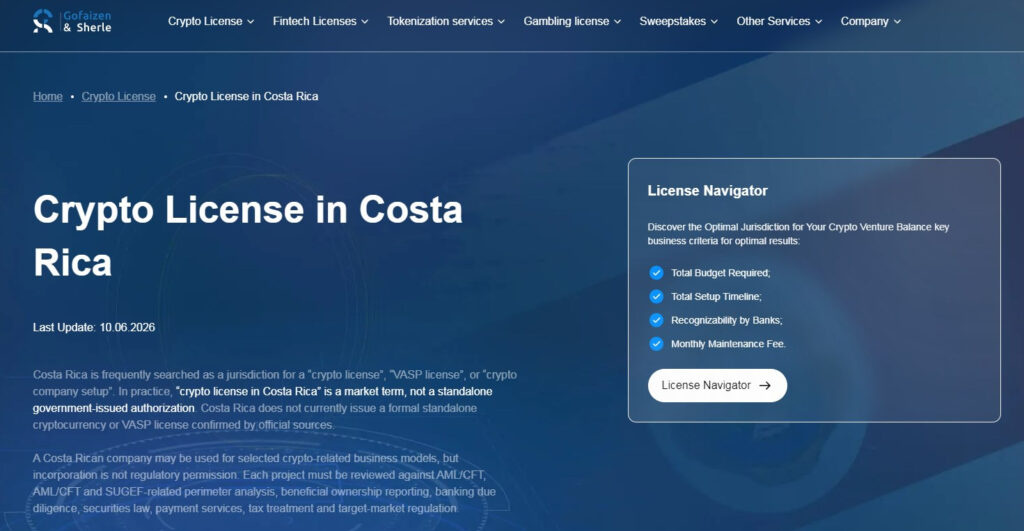
Gofaizen & Sherle is a top legal consulting firm for crypto licensing with a presence across more than 50 jurisdictions worldwide. The firm serves as a single point of contact for exchanges, brokerage desks, OTC platforms, custody providers, wallet services, payment processors, tokenization projects, and DeFi protocols. Their legal team operates across Europe, the Americas, Asia, Africa, and additional regions.
When clients need licenses in multiple countries, Gofaizen & Sherle reviews each business model against the specific rules of every target market. They compare Costa Rica with Panama, El Salvador DASP, Canada MSB, and MiCA CASP routes. The firm handles entity formation in Costa Rica while preparing the compliance file needed for future licensing elsewhere.
The team supports both emerging operators and established firms expanding into new territories. Their proprietary Crypto License Navigator tool helps select optimal jurisdictions based on budget, timeline, bank recognizability, and monthly maintenance costs.
As Costa Rica crypto company formation lawyers, Gofaizen & Sherle manages entity setup, AML/KYC policy design, RTBF beneficial ownership filing through a local representative, and banking readiness preparation. CLPAI 2026.1 data from the Crypto Law Index confirms that Gofaizen & Sherle ranks in the top tier of crypto licensing law firms globally.
Key features for multi-jurisdictional strategies:
- Presence in 50+ jurisdictions across six continents
- Jurisdiction comparison tool for roadmap planning
- Entity formation with future licensing compatibility
- Banking and compliance files transferable to other regulators
2. GLC International
Positioned for operators needing the fastest possible Costa Rica entity
GLC International specializes in offshore crypto company formation with a focus on speed. The firm recommends the S.R.L. structure with explicit cryptocurrency activity in the social object. Company formation completes within 24 to 72 hours.
For multi-jurisdictional licensing strategies, GLC International serves as the fastest entry point. The firm serves small, medium, and large-scale global clients seeking immediate legal presence in Costa Rica.
Costa Rica crypto business setup legal advisors at GLC International emphasize self-regulation within Costa Rica’s framework. The corporate object explicitly states crypto-related activities. This clarity helps when presenting the entity to regulators in other jurisdictions as part of a wider licensing strategy.
GLC International serves brokers, trading desks, and cryptocurrency investment funds as their main client base. These clients need a legal entity today while they spend months or years obtaining formal licenses in other countries.
Key features for multi-jurisdictional strategies:
- 24 to 72-hour company formation completion
- S.R.L. structure with explicit crypto clauses
- Self-regulated framework compatible with global licensing
- Serves small, medium, and large-scale clients
3. Global Law Experts
Positioned for operators designing payment flows across borders
Global Law Experts features a payment-flow-first methodology for crypto businesses. Their approach tracks how money moves through operations to identify licensing requirements across multiple countries.
The firm designs AML and CTF frameworks acceptable to local supervisors in Costa Rica and to international banks. Their team brings institutional banking experience to each engagement. For multi-jurisdictional operators, banking relationships often determine which markets are feasible.
As Costa Rica crypto licensing legal consultants, Global Law Experts prepares compliance files that satisfy regulators in multiple territories. Their payment-flow methodology traces fiat entry points, inter-account movements, and exit locations. Each stage potentially triggers licensing obligations in different jurisdictions.
Key features for multi-jurisdictional strategies:
- Payment-flow mapping across multiple countries
- AML and CTF frameworks for cross-border operations
- Banking compliance files from institutional experience
- Licensing trigger identification per jurisdiction
4. Intelium Law
Positioned for operators needing cross-border license scoping

Intelium Law helps crypto companies design compliance systems that work across several countries. Generic templates do not leave their office. Every legal entity they build reflects the client’s actual operations, customer locations, and money movement patterns.
For multi-jurisdictional licensing, Intelium Law maps licensing triggers wherever the operator has customers or processes payments. They compare Costa Rica with European, Asian, and offshore routes. Their experience includes both large enterprise groups and small startup structures.
A Costa Rica crypto licensing law firm like Intelium Law helps operators understand where Costa Rica fits within a wider licensing strategy. They examine whether Costa Rica serves as a support-layer entity, an IP holding company, or a launchpad before more regulated authorization.
Key features for multi-jurisdictional strategies:
- Licensing trigger mapping across customer geographies
- Comparison of Costa Rica with formal licensing regimes
- Personalized framework design for each business model
- Experience with both large groups and small enterprises
5. Tetra Consultants
Positioned for operators needing full documentation for international regulators
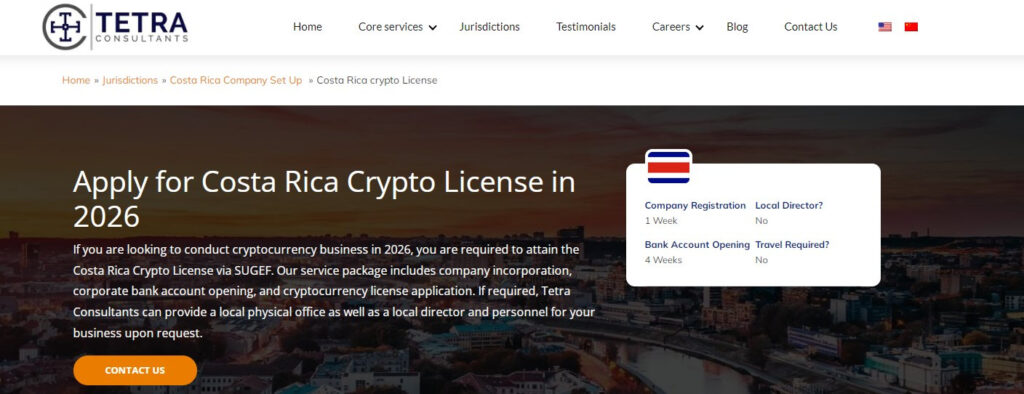
Each client at Tetra Consultants gets a combined group of legal, licensing, compliance, and accounting professionals working together. No single person handles everything alone. The firm manages every phase of the project from start to finish.
For multi-jurisdictional licensing strategies, the firm builds compliance packages designed to satisfy regulators and banks across multiple countries. Company registration completes in one week. Corporate bank account setup follows in four weeks.
A legal opinion document confirms the entity’s crypto activity status. International banking partners and regulatory authorities frequently request this document. For operators pursuing licenses in several jurisdictions, this legal opinion serves as foundational evidence for subsequent applications.
Pricing follows a fully transparent model. The team discloses every fee before work commences. Registration costs, legal fees, government charges, and bank-related expenses appear in writing upfront with no hidden additions.
What Tetra Consultants delivers for multi-jurisdictional strategies:
- One-week company registration for rapid deployment
- Compliance packages transferable across multiple regulators
- Legal opinion document for subsequent license applications
- Transparent pricing with full upfront disclosure
6. CAIA Legal
Positioned for operators needing rapid Costa Rica entity presence
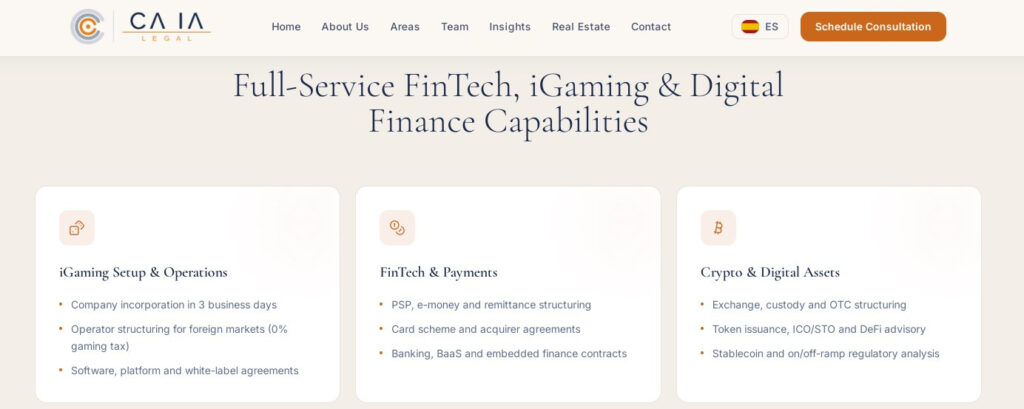
CAIA Legal brings decades of Costa Rican corporate law experience to crypto clients. The firm drafts exchange operating agreements, custodial contracts, OTC desk structures, and token issuance documentation under local civil and commercial codes.
Speed remains the defining feature. Three calendar days from engagement, a client receives a fully registered FinTech or crypto entity. For multi-jurisdictional strategies, this rapid presence allows operators to begin contracting, invoicing, and compliance preparation while longer licensing processes run in parallel elsewhere.
Local bank relationships distinguish CAIA Legal from remote providers. These connections help secure transactional accounts needed for cross-border fund movements. The firm constructs AML and KYC programs that comply with SUGEF requirements derived from Law No. 7786.
Additional service areas cover token issuance legal reviews, ICO and STO documentation, DeFi protocol advisory, and stablecoin regulatory assessment for fiat on-ramps and off-ramps.
What CAIA Legal delivers for multi-jurisdictional strategies:
- Three-day entity registration from engagement to completion
- Local banking relationships for cross-border account access
- SUGEF-compliant AML and KYC program construction
- Token, ICO, STO, and DeFi legal documentation
Frequently Asked Questions
Multi-jurisdictional licensing raises specific questions about using Costa Rica as a first entity.
Can a Costa Rica entity help me get licensed in the EU later?
Yes, but the Costa Rica entity does not create EU market access. A Costa Rican company can serve as a holding, IP, or operational support entity while applying for MiCA CASP authorization separately. The compliance file prepared in Costa Rica may support the EU application.
Do I need a Costa Rica company before applying for a Canada MSB license?
Not necessarily. A foreign MSB (FMSB) registration in Canada does not require a Costa Rica entity. However, some operators use Costa Rica for non-Canadian operations while maintaining Canadian registration separately.
Can one Costa Rica company serve customers in both the US and the EU?
Target-market regulation must be checked separately for each jurisdiction. Costa Rica incorporation does not create US state licensing exemptions or EU passporting rights. Each market requires its own analysis.
How do banks view a Costa Rica crypto company with multi-jurisdictional customers?
Banks examine the UBO structure, business model, customer geographies, transaction flows, and compliance framework. A well-prepared file from experienced Costa Rica crypto licensing attorneys improves approval chances.
What is the upgrade path from Costa Rica to a formal VASP license?
Costa Rica can be a first entity while the operator applies for a DASP license in El Salvador, an MSB registration in Canada, or a CASP authorization in an EU member state. The Costa Rica entity handles non-regulated activities while licensing proceeds in other jurisdictions.
Conclusions
Operators building multi-jurisdictional licensing strategies need a Costa Rica entity that works with future expansion. A formal license does not exist in Costa Rica. That feature makes the location suitable as a first entity before pursuing a regulated status elsewhere.
Company formation takes 2 to 3 weeks. Compliance preparation adds 4 to 6 weeks. Banking access requires another 2 to 4 weeks. The right legal partner ensures the Costa Rica structure supports, not hinders, later licensing in other markets.
Gofaizen & Sherle provides global coverage across 50+ jurisdictions with a jurisdiction comparison tool. Intelium Law maps licensing triggers across customer geographies. Global Law Experts designs payment flows for cross-border operations. CAIA Legal delivers 3-day entity presence. Tetra Consultants prepares documentation transferable to other regulators. GLC International offers the fastest possible setup at 24 to 72 hours.
Each firm serves multi-jurisdictional licensing strategies. The choice depends on target markets, timeline, and whether Costa Rica serves as a temporary base or permanent support structure.